Futures Prop Firms With No Consistency Rule: Full List
Futures prop firms with no consistency rule deserve a hard look from anyone whose P&L comes in bursts — one or two big days a month carrying a string of small ones, which describes most real traders. A consistency rule caps how much of your profit may come from a single day (commonly 30–50%), and breaking it doesn't just delay a payout at some firms — it can void eligibility until you grind the ratio back down. If your equity curve is lumpy, this rule matters more to you than the profit split.
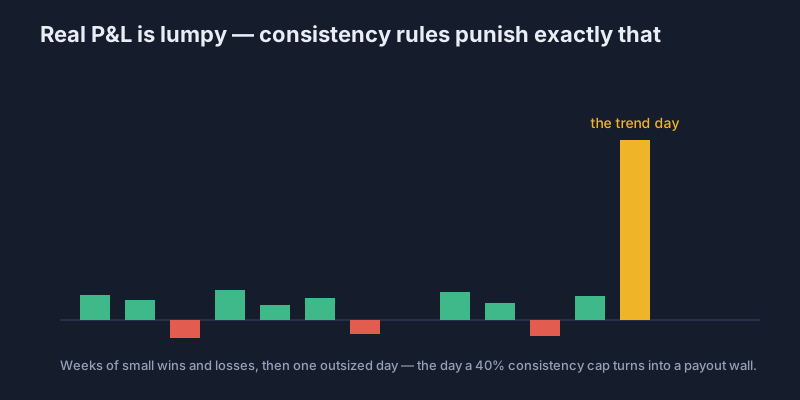
How a consistency rule actually bites
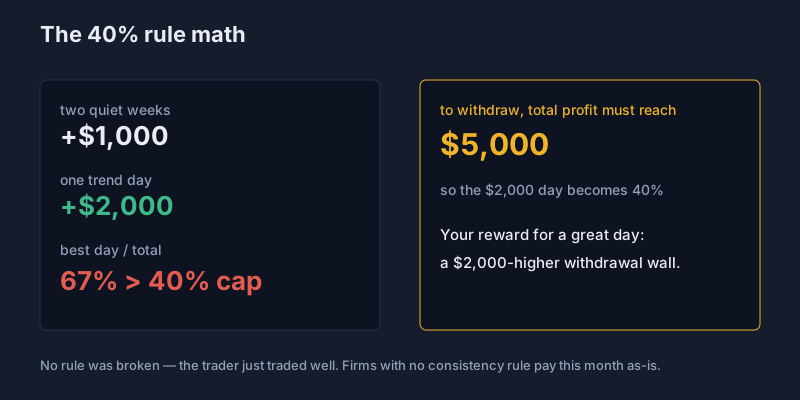
The math is sneakier than it looks. Say a firm caps any single day at 40% of total profit, and you're up $1,000 over two quiet weeks. Then you catch a trend day for $2,000. Your best day is now $2,000 of a $3,000 total — 67%. You didn't break a risk rule, you traded well — and you're now ineligible to withdraw until total profit reaches $5,000, so the big day shrinks to 40%. Your reward for a great day is a higher withdrawal wall.
Common consequences across the industry:
- Payout requests denied or delayed until the ratio normalizes
- Eval passes voided when one day exceeds the cap (eval-only rules)
- Traders forced to keep trading — and risking profits — purely to fix a ratio
The firms with no consistency rule on funded accounts
These recommended firms from our research have no consistency requirement once you're funded — your $3,000 month pays the same whether it came from twenty days or one:
Eval-only rules: usually an acceptable trade
Several good firms run a consistency rule during the evaluation only, then drop it on the funded account. That's a much softer constraint — an eval is short, and you can pace it deliberately. What you should refuse to accept is a consistency rule that governs payouts, because that's a rule standing between you and money you already earned. Each of our firm reviews states which kind you're dealing with in the "rules that matter" table.
How to shortlist
Treat "no consistency rule on funded" as a strong preference and combine it with the drawdown filter — the intersection of that list and prop firms with EOD drawdown is a very short, very safe shortlist. The quiz asks about exactly this ("my P&L is lumpy") and penalizes rule-heavy firms in your results.
Quick answers
What is a consistency rule at a prop firm?
A cap on how much of your total profit may come from a single trading day — commonly 30–50%. Exceed it and, depending on the firm, your payout is delayed, your eval pass is invalidated, or you must trade until the ratio falls back under the cap.
Why do prop firms use consistency rules?
Officially, to filter for repeatable trading rather than one lucky trade. Practically, it also delays payouts and increases the chance a trader gives profits back before withdrawing. Both things are true at once.
Is a 50% consistency rule hard to break accidentally?
Easier than it sounds early in an account's life, when total profit is small — your first good day is often more than half of a small total by definition. Rules that only count from a minimum profit base are fairer; the reviews note the mechanics per firm.
Skip the reading — answer 7 questions and get matched to the right firm for how you actually trade.
Take the 60-second quiz