Prop Firms With EOD Drawdown: Every Firm That Offers It
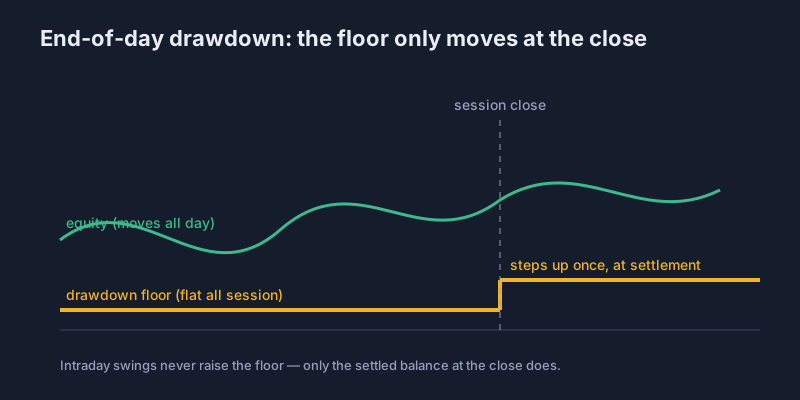
Prop firms with EOD drawdown are the ones most traders should shortlist first, because the drawdown type is the single rule that decides whether a normal losing streak ends your account or just dents it. End-of-day drawdown only updates at the session close — your open trades can breathe intraday without stopping the account out at its equity high. This guide lists every futures firm in our research that offers it, and flags the fine print that catches people after they get funded.
Why the drawdown type matters more than the profit split
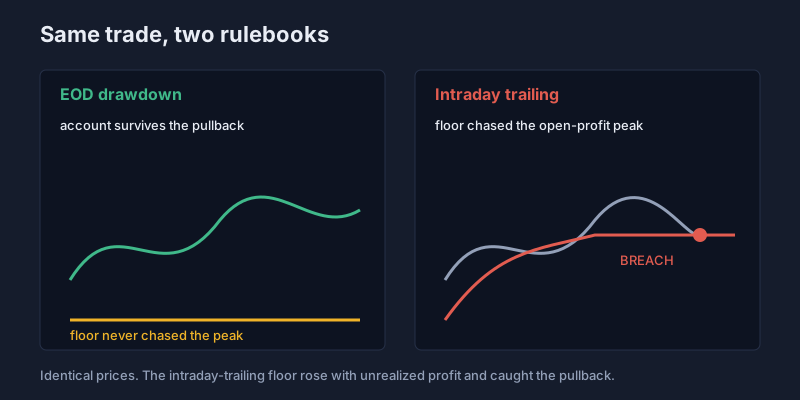
A trailing drawdown is a moving floor under your account. The only question that matters is when it moves. An intraday trailing drawdown follows your open equity tick by tick — if a trade runs $1,500 in your favor and comes back to breakeven, your floor just rose $1,500 even though you banked nothing. End-of-day versions only recalculate once, at the close, using your settled balance.
In practice that means an EOD account survives things an intraday account can't:
- Scaling into a position that dips before it works
- Holding a runner through a pullback instead of panic-flattening
- A normal red morning that recovers by the afternoon
- Spread and slippage noise on volatile opens
Traders consistently misjudge this: a 90/10 split on an intraday-trailing account is frequently worth less than 80/20 on an end-of-day account, because the second account is far more likely to survive long enough to pay you at all.
The firms that offer it
From our current 16-firm research, these are the recommended firms running end-of-day drawdown, with the score each earned in our independent review:
| Firm | Score | Drawdown | Eval (~50K) | Payouts |
|---|---|---|---|---|
| Tradeify | 8.0 | EOD | — | Growth and Select Flex: payout per 5-winning-day cycle with per-cycle caps. Select caps were re-cut by purchase date on 2026-09-01: accounts bought on or after 1 September 2026 get Select Flex caps of $1,250/$2,500/$3,500/$4,500 and Select Daily caps of $600/$1,250/$1,750/$2,500 by size, which cuts the Flex 50K/100K/150K caps (from $3,000/$4,000/$5,000) while raising the Daily 50K and 100K caps (from $1,000/$1,500). Accounts bought before that date keep the old caps. Select Daily: payout any day once a $1,100 to $3,600 buffer is reached ($6,100 on the 300K V2), min $250 on 25K to 150K. The Select 300K Daily path replaces the 2x continuity multiplier with a flat $4,000 daily cap plus a 50% new-profit rule; 300K Flex needs $750 winning days and caps at 50% of profits up to $10,000. Processing 24 to 48h via Rise. |
| Topstep | 8.0 | EOD | $49 | Per-request during CME hours. Standard path: 5 winning days of $150+ per cycle, caps $2,000/$3,000/$5,000 (50K/100K/150K); Consistency path: 3 trading days + 40% consistency, caps $3,000/$4,000/$6,000. The optional Daily Loss Limit add-on doubles these caps on qualifying new purchases (up to $12,000). Max 50% of balance per request; min $125; MLL resets to $0 permanently after every payout. |
| FundedNext Futures | 7.0 | EOD | $70 | NOT unlimited: Flex, Rapid Pro and Rapid Daily accounts are concluded after the 5th Performance Reward withdrawal (Legacy is exempt: it unlocks 100% withdrawals after 30 benchmark days). Min withdrawal $250 everywhere. The minimum profit required in the current cycle is $500 ON EVERY PLAN, including Rapid Daily. THE $250 RAPID DAILY SPLIT IS OVER: article 15878210 was rewritten on 2026-09-09 and now states $500 four times, agreeing with joint articles 15877643 and 15878201, so the $250 figure it published between 2026-08-30 and 2026-09-08 was an editing error that has since been corrected rather than a rule that changed twice. Note that $500 is the cycle-profit gate while $250 is the minimum withdrawal amount; they are different numbers and both are live. Flex: 5 benchmark days per cycle at $200 (50K, 100K) or $250 (150K), up to 50% of accumulated profit capped at $1,500/$2,500/$4,000 by size; cap lifted on the 5th withdrawal. Legacy caps are higher, at $3,000 on 25K and $6,000 on both 50K and 100K. Rapid Pro: every 3 days plus a 40% consistency rule, caps $800/$1,200/$2,500. Rapid Daily: daily, same caps, but only profit above the buffer (starting balance plus max loss limit plus $100) is withdrawable. Reaching live remains UNRESOLVED and the count of surfaces has now moved to the 5-withdrawal framing without settling the question. Three surfaces describe 5 withdrawals from a SINGLE Flex account as the live route: article 14269280 (re-edited 2026-09-21T06:51:16Z) 'You can move to live trading as early as 5 withdrawals of your Performance Reward from a single Flex Account', article 14283903 (dateModified 2026-08-29T08:26:38Z) '$100,000 in Total Active Profits or 5 withdrawals from a single Flex Account', and the live Flex product page 'Five reward journeys from one FundedNext account. Complete all five to enter the live funding review pool.' Two surfaces still require 15: article 16522296 (dateModified 2026-09-03T10:49:03Z) and the Flex-specific article 15430139 (dateModified 2026-08-15T06:45:45Z), both reading 'Earn 15 Performance Rewards during your FundedNext journey to enter the live review pool', with returning traders re-entering every 5. The conflict is NOT a Flex-versus-other-family split, because both framings are written about Flex, and it is not resolvable on recency, because the 15-reward text sits on the two dedicated Road To Live articles while the 5-withdrawal text sits on a withdrawal how-to, a superseded Legacy-era live article and a marketing page. Report both; do not pick one. The $10,000 figure is NOT a cumulative live-deposit cap: it is the Reserve full-match band, where the first $10,000 withdrawn cumulatively is matched 1:1 and anything above it at $1 per $2. The 15-Challenges-per-month purchase cap was removed on 2026-09-01 and replaced by a cap of 10 FundedNext accounts issued per calendar month; the 5 concurrent accounts per user or household and the $750,000 allocation cap are unchanged. |
| Top One Futures | 6.0 | EOD | $39 | Elite Daily V2: payout request every 24h once the buffer is met. Buffers are $1,500 (25K, min balance $26,500) / $2,500 (50K, min $52,500) / $3,500 (100K, min $103,500) / $4,500 (150K, min $154,500); max per request $750 / $1,000 / $1,500 / $2,250; min request $500; at least 50% of each request must be profit earned since the last payout, and buffer profits are forfeited on breach. Five successful payouts is the standard path to live. Elite Access: on demand after 5 profitable trading days, subject to the 40% consistency and 50% daily progression rules, min request $500. |
| Funded Futures Network (FFN) | 4.0 | EOD | $80 | Standard MAX: request once the buffer is fully built, the balance is at least $500 above the buffer level, and the account is inside the 40% consistency rule, with no winning-day requirement, processed same day. STEADY: five winning days per payout cycle (min daily profit $100/$150/$200/$250/$350 by size), plus a 'net rule' requiring the balance to exceed the prior post-payout level. Min withdrawal $500. Tiered per-account caps effective 20 Apr 2026: payouts 1-3 are capped at $1,000/$1,500/$2,000/$2,500/$3,000 and payouts 4+ at $1,200/$2,000/$2,500/$3,000/$3,500 for 25K through 250K. A separate $10,000 per-user cap applies per payout event across all accounts, and the lesser of the two governs. Live-funded accounts have no payout caps and no consistency rule. After 5 sim payouts a STEADY account goes to live review, and accounts bought after 1 Jul 2026 forfeit all accumulated sim profit on the move to live. |
The trap: firms that switch after you pass
Read the funded-account terms, not just the eval page. The most common trick in the industry is advertising end-of-day drawdown on the evaluation, then converting the account to intraday trailing once you're funded — exactly when the rule starts costing you real money. Our firm reviews flag every firm in our data that does this, and it factors into their score.
Second fine-print item: some firms cap how far the drawdown trails before it locks (usually at your starting balance plus a buffer). A locking drawdown is a genuine upgrade — after enough profit, the floor stops chasing you entirely. When two firms both offer end-of-day, the one whose drawdown locks should win the tiebreak.
How to choose among them
Drawdown type is a filter, not a verdict — after applying it you still care about payout record, real discounted cost, and consistency rules. The fastest route is our 60-second matching quiz, which treats end-of-day drawdown as a hard preference and scores the remaining firms against your style and budget. Or start from the full rankings and read the individual reviews linked in the table above.
Quick answers
Is EOD drawdown always better than intraday trailing?
For account survival, yes — it forgives intraday equity swings that an intraday trailing floor would turn into a breach. The trade-off is that firms price it in: end-of-day accounts often cost slightly more or pay a slightly lower split. Most traders should still take that trade.
Do any firms offer static drawdown instead?
A few offer static (fixed) drawdown on certain plans — the floor never moves at all. It's the most forgiving structure but usually comes with smaller size or higher cost. Check the individual firm reviews for which plans carry it.
Can a firm change my drawdown type after I'm funded?
Some firms' funded accounts use a different drawdown than the eval by design — that's disclosed in the terms, and it's the main trap this article warns about. Read the funded-account rules before buying the eval, not after passing it.
Skip the reading — answer 7 questions and get matched to the right firm for how you actually trade.
Take the 60-second quiz